

a tarsier in Linan
They have become one of Philippine’s tourism mascots, figuring in posters and logos including the most recent Department of Tourism’s (failed) “Pilipinas Kay Ganda” logo. Although they are found in various places in the archipelago (central eastern and southern provinces), most people associate the tarsier with the island of Bohol.
Imagine my surprise when I found out that these endangered primates are thriving practically right in my province’s backyard.
There had been reported sightings of tarsiers in the forested areas of South Cotabato, like the areas near Mt. Parker or the settlements at the foot of Mt. Matutum. But I guess nobody really gave that much attention until people started noticing images of tarsiers on souvenir t-shirts from Bohol. Their first reaction: “So they are called tarsiers… we’ve seen those in the hills near our village”. The B’laans call tarsiers “tukay mal” or “small monkey”.
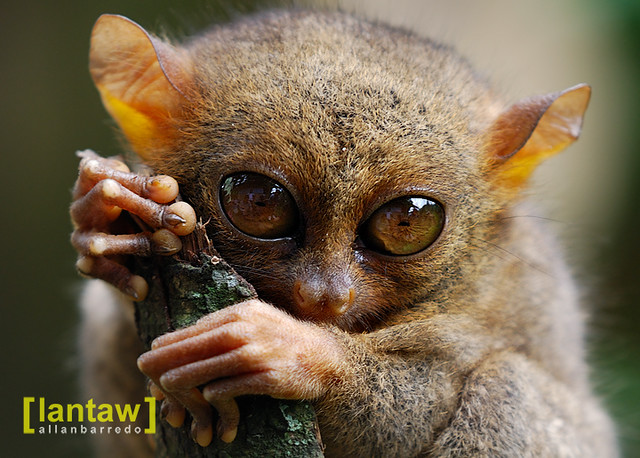
tukay mal
It was just recently (the project started July 2010) that the provincial government of South Cotabato started seriously advocating the protection of their habitat. According to the local officials, it was hard at first to convince the locals to stop their slash and burn practices. Charcoal-making is also the most common source of livelihood – that meant cutting trees. Eventually people realized the importance of the wildlife around them. They stopped their destructive practices and the forest rebounded. Now there is a healthy population of tarsiers near Bagong Silang – a small B’laan village in Brgy. Linan in Tupi. Linan, located at the foot of Mt. Matutum, is now known as the (unofficial) “tarsier sanctuary” of South Cotabato.
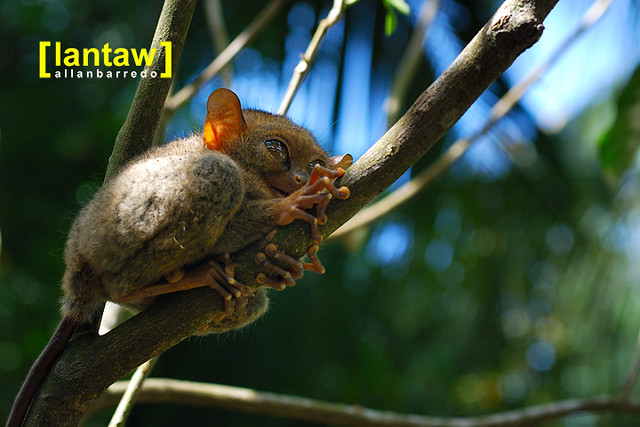
built for jumping
In Bohol they have developed a semi-wild enclosure to keep the tarsiers in, but tarsiers in Linan, which could be another subspecies, are wild. The first time I went to Linan I was not able to see one. Contrary to what some think, tarsiers are fast – they can jump several meters from tree to tree (thanks to their very long hind legs – they have long tarsus bones, hence their name) and they hide in burrows or holes/cracks on trees/rocks. Catching one in the wild isn't easy.

close encounter
I was finally able to see a Linan tarsier few weeks ago when my family and several friends went there to distribute school supplies to the B’laan kids (a family outreach project). We “borrowed” one from the nearby forest and release it again after we took photos. There are days when you can find the tarsiers just near the perimeter of the village.

sharp teeth - perfect for munching on crickets
The tarsier looked timid, but it’s actually a predator, feeding on insects primarily and is known to hunt small birds and lizards too. They are nocturnal but some could also be active during the day. Philippine tarsiers are said to be territorial and usually sleep and hunt alone.
Some villagers had once tried keeping them as pets, but they are known to kill themselves in captivity. Now they are aware of how precious these tarsiers are and how they need to be protected. A lot of work still needs to be done if the local government wants a sustainable conservation program just like what they are doing in the Philippine Tarsier sanctuary in Corella in Bohol.
Aside from tarsiers, forested area at the foot of Mt. Matutum is also home to squirrels, flying foxes, civets, and several species of eagles.
26 comments:
I have never seen one yet, but will soon convince the husband to go trekking to Linan. Thanks for the nice pictures.
whoa! gaganda ng mga kuha bai. gusto ko rin to makita.
sheng, dom, kung punta kayo dun sabihin nyo para ma inform ko yung mga kilala ko dun ahead of time
They are so cute :-)
I saw them in Bohol.
Nice pictures... you even made them smile ! :-)
i didn't know na may tarsier pala sa cotabato. thanks for sharing the info. sabi ni kuya kim may tarier din daw sa ibang bansa. cool!
@Sidney, he probably thought my fingers are juicy crickets :D
@James, marami sa Sarangani and South Cotabato area. Don't know kung meron sa din sa Cotabato.
wow! ganda ng mga kuha! sir pagamit ng photos for http://magazine.southcotabato.org ha.. more power!
Such a charming animal! I love the shots--shows off the tarsier's details very well.
love the Tarsier smile :)most of the pics I saw have them mouths closed
The blog is fantastic, however, promoting Tarsier pictures awake in the day time is highly misleading. This species is truly nocturnal, depciting them as day-dwelling animals only encourages people to take pictures with them and wanting them as pets.
Thanks
@anonymous (no guts to put in your name?), people can read and they know these animals are noctural. Next time I'll display a black photo and say that's a tarsier photo taken in pitch black darkness
we will visit these tarsiers soon, in time for the T'nalak Festival....aside from this attraction, there are so many places in South Cotabato that need to be visited...hope others can come too.....
nice blog... hope u will allow us to get published your pic in our school paper
These are one of the best Linan tarsier photos I've seen so far, Allan. May I ask for permission to borrow some for my blog post? Of course proper credits will be given..
Love the shots!
@Bonedoc, thanks! I'm not sure though if others (aside from me) can use the photos because they are currently licensed under Getty images
Whoa! I didn't know South Cotabato has one. I've always wanted to go to Bohol to see one. Thanks for sharing. Your blog is awesome!
In that case, I'll not use it hehe. Better me safe. haha. But thanks for the permission from the owner :) Geez I wish I'm this good on animal photos...tarsiers at that
] Thanks allan!
@Carmela, South Cotabato has a lot of "hidden treasures" :)
beautiful pictures, borrowed it for one of my post, hope you don't mind with proper credit of course, thank you again.
@journey of a dreamer, I do mind if people use the photos without actually waiting for explicit permission
thank you anyway, i have removed it my blog post.
@lantaw Indeed it has ^_^
for those who want to see this lil creature you are welcome to visit the sanctuary, but captivation of these animals is now highly prohibited, if you really want to look at them closer, you should have to trek along the sanctuary and look for them in wild. The native people in the village are no longer permitted to capture such for display.
you can contact the Tourism office in Tupi for inquiries.
Thank you.
Do you have contact numbers of the Tarsier Sanctuary? My class would like to inquire if when can we visit the place for our educational trip.. thanks
Its best to contact South Cotabato's tourism office Telefax No. (+63)(83) 228 3447
Tel : (+63) (83) 878 2140
@Lantaw
Wow! Nice photo 😍 Wanna see one. May contact number po ba kayo doon? Coz I really wanna go there. Kasi need pa ata ma inform yung taga doon ahead of time. Thanks po! Ito po number ko. 09128769109
Post a Comment